
Confidence for Southern Oregon's Roads, Weather, and Adventures
From rainy mornings in Medford to snowy mountain passes, Southern Oregon drivers encounter a remarkable variety of road conditions.
That's one reason Subaru's Symmetrical All-Wheel Drive has become such a familiar feature of life in the Rogue Valley.
But what exactly does Symmetrical AWD do? How does it work? And what's the difference between AWD and Subaru's X-MODE?
Let's explore the technology, its advantages, and what it means for your everyday driving.
What Is Subaru Symmetrical All-Wheel Drive?
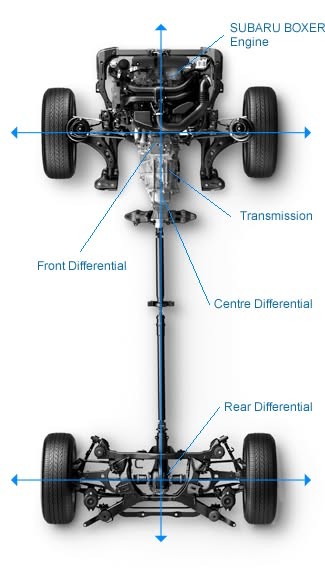
Subaru Symmetrical All-Wheel Drive is a system designed to deliver engine power to all four wheels while continuously adjusting how that power is distributed to help maintain traction.
Unlike conventional two-wheel-drive vehicles, which primarily send power to either the front or rear wheels, Symmetrical AWD can use all four wheels to help move the vehicle.
The word symmetrical refers to the balanced, largely mirror-image arrangement of the drivetrain around the vehicle's centerline.
In Subaru's gasoline-powered models, the system works with the horizontally opposed SUBARU BOXER® engine, which sits relatively low in the vehicle.
Together, this layout helps provide balanced handling, stability, and predictable driving characteristics.
Symmetrical AWD is standard on nearly every Subaru model, with the rear-wheel-drive Subaru BRZ being a notable exception.
How Does Symmetrical AWD Work?
Think of the system as constantly evaluating the driving conditions and adjusting the distribution of power to help the vehicle maintain traction.
It monitors information such as wheel speed, acceleration, and vehicle behavior.
Under normal conditions, power is distributed according to the needs of the vehicle and its particular AWD system.
When conditions change, the system can adjust torque distribution to help maintain traction.
For example:
- On dry pavement: AWD operates continuously while adjusting power distribution for smooth, responsive driving.
- On wet roads: The system can adjust torque delivery as traction conditions change.
- On snowy surfaces: Power delivered through all four wheels can help the vehicle accelerate and maintain forward progress.
- On loose gravel: AWD can help manage traction when individual wheels encounter surfaces with different levels of grip.
Unlike a traditional manually engaged four-wheel-drive system, Subaru drivers don't need to turn Symmetrical AWD on when the weather changes. It's already working.
What Are the Advantages for Southern Oregon Drivers?
1. Confidence During Rainy Rogue Valley Winters
Rain can create slick conditions, particularly when it mixes with accumulated oil and debris on road surfaces.
Subaru Symmetrical AWD helps distribute power among the wheels, supporting traction during acceleration and everyday driving.
That can be particularly reassuring during our wet fall and winter months.
2. Added Traction on Snowy Mountain Roads
Driving conditions can change dramatically between the Rogue Valley floor and higher elevations.
Routes toward Crater Lake, Lake of the Woods, or Siskiyou Summit may encounter snow, slush, and icy patches even when Medford roads are clear.
Subaru AWD can help drivers maintain forward traction on slippery surfaces.
However, proper tires and cautious driving remain essential. AWD does not significantly improve braking traction on ice simply because all four wheels receive power.
3. Greater Versatility on Gravel and Rural Roads
From the Applegate Valley to rural roads throughout Jackson and Josephine counties, many Southern Oregon drivers regularly encounter gravel, dirt, and uneven surfaces.
Symmetrical AWD helps manage power distribution as available traction changes, making it useful well beyond winter weather.
4. Everyday Driving Stability
The benefits of Subaru AWD aren't limited to snow and mud.
Its balanced drivetrain design and continuously managed power distribution are intended to deliver responsive, predictable driving in everyday conditions.
It's a feature you can appreciate year-round.
What Is Subaru X-MODE?
X-MODE is a driver-selectable feature on many Subaru vehicles that works alongside Symmetrical All-Wheel Drive.
While AWD continuously manages power distribution, X-MODE coordinates additional vehicle systems to help maximize traction and control in particularly challenging conditions.
Depending on the model, X-MODE can adjust:
- Engine or motor response
- Transmission or drivetrain behavior
- All-wheel-drive torque management
- Traction and stability control
- Braking intervention to help control wheelspin
Rather than relying only on the driver to manage the accelerator, X-MODE helps coordinate the vehicle's response to low-traction situations.
Symmetrical AWD is your everyday traction system. X-MODE provides extra assistance when conditions become especially difficult.
What's the Difference Between Standard and Dual-Function X-MODE?
Different Subaru models and trim levels offer different X-MODE configurations.
Standard X-MODE
Designed to help improve low-speed traction in slippery conditions, such as snow-covered roads, muddy surfaces, or uneven terrain.
Dual-Function X-MODE
On equipped models, drivers can select between two settings:
- Snow/Dirt: Optimizes traction and controlled progress on slippery surfaces such as packed snow, dirt, and gravel.
- Deep Snow/Mud: Allows more wheelspin when appropriate, helping maintain momentum through deeper snow or muddy conditions.
Not every Subaru offers the same settings or operating speeds. Your owner's manual and Southern Oregon Subaru Sales Professional can explain the features on your particular model.
What Is Hill Descent Control?
On equipped vehicles, X-MODE incorporates Hill Descent Control, a particularly useful feature for challenging downhill terrain.
When operating within its designed speed range, Hill Descent Control can automatically manage braking to help maintain a controlled descent.
This allows the driver to concentrate more on steering and choosing a safe path.
For example, imagine carefully descending a steep, loose-surface road after visiting a remote Southern Oregon trailhead.
Hill Descent Control can help the vehicle maintain a controlled speed without requiring constant manual brake adjustments.
It is an aid, not a substitute for choosing a safe route and maintaining control of the vehicle.
When Should You Use X-MODE?
| Driving situation | Recommended approach |
|---|---|
| Normal dry pavement | Symmetrical AWD operates automatically |
| Typical wet-road commuting | AWD operates automatically; X-MODE generally unnecessary |
| Light snow on maintained roads | AWD normally sufficient with appropriate tires |
| Challenging low-speed snowy or muddy terrain | Consider X-MODE when appropriate |
| Deep snow or mud | Dual-Function Deep Snow/Mud, if equipped and appropriate |
| Steep, slippery downhill terrain | X-MODE with Hill Descent Control, if equipped |
Always follow the owner's manual for your model and year. X-MODE is intended for specific operating conditions and may disengage or change behavior at higher speeds.
Does AWD Mean You Don't Need Winter Tires?
No. This is one of the most important things every driver should understand.
All-wheel drive can improve traction when accelerating or maintaining forward progress, but it cannot create grip that the tires don't have.
Braking and steering depend heavily on tire traction, road conditions, and vehicle speed.
For mountain driving in Southern Oregon, appropriately rated tires can make an enormous difference.
Also, Oregon's traction tire and chain requirements still apply to AWD vehicles. Exemptions depend on specific conditions, and drivers should check current requirements before traveling through snow zones.
Visit TripCheck.com for current road conditions.
Subaru Symmetrical AWD provides valuable traction advantages when roads become slippery. But even the best AWD system can't replace good tires, sensible speeds, and safe following distances. Understanding both the capabilities and limitations of your vehicle helps you become a safer, more confident driver.